Layered communities
The City’s history identifies Sun City, Quail Valley, and portions of Romoland within Menifee. A local page should not treat the city as one uniform neighborhood or one customer type.

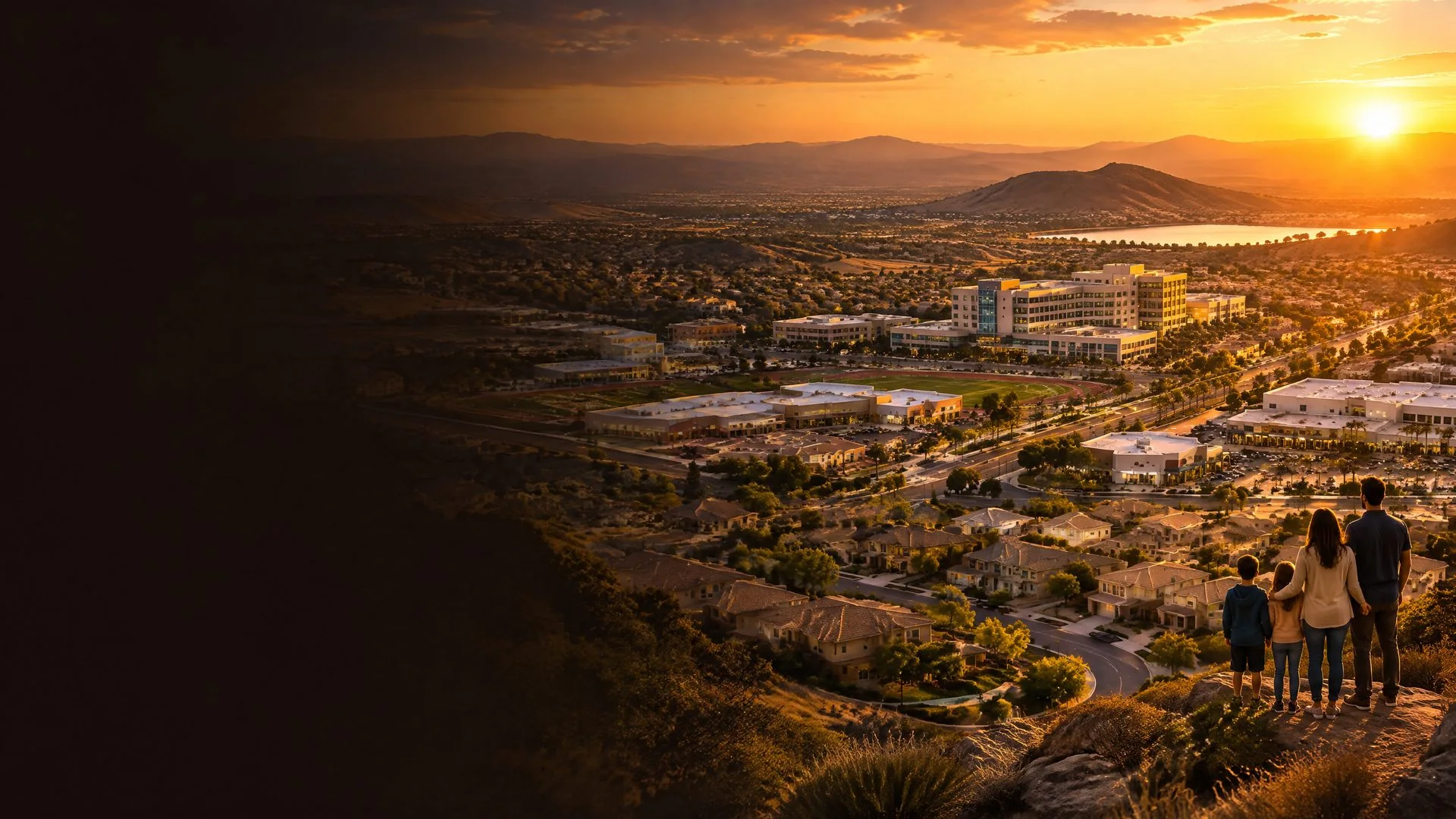
A Menifee website should give a customer the answer they need now: what the business does, whether it fits their need, where or how it serves, and how to take the next step.
These city-level figures provide practical context for access and communication. They do not define any individual visitor, customer, household, budget, language, or need.
Menifee is shaped by established communities, newer growth, and a north–south I-215 economic spine. The City’s planning language balances corridor development with residential and rural character—an honest foundation for a website that creates clear decision points rather than a generic city template.
A clear decision at every turn
Growing Crossroads uses short, predictable paths through a site: choose a service, understand the fit, see the service area, validate the proof, and make contact. The visual idea is connection and progress, not freeway decoration or a claim that every visitor travels the same way.
The City’s history identifies Sun City, Quail Valley, and portions of Romoland within Menifee. A local page should not treat the city as one uniform neighborhood or one customer type.
The City identifies I-215 and adjacent Economic Development Corridors as a local growth framework. The useful website translation is connection: practical routes to services, proof, and contact.
City policy links corridor activity and infill to the preservation of rural, estate, and residential character elsewhere. The page should feel forward-moving without making boomtown claims.
A clear website is built around situations people are actually in, not a collection of vague demographic labels.
Menifee includes Sun City, Quail Valley, portions of Romoland, and newer neighborhoods along the I-215. A website should say which of those needs it actually serves instead of treating the city as one customer.
A modular website helps a business introduce new services, hours, proof, and inquiry paths without starting over.
Service fit, coverage, qualifications, price approach, and a contact choice should be clear before a visitor needs a long form.
Age or grade fit, schedule, enrollment, location, and accessible contact need to be immediately visible.
Plain language, readable type, direct calling, and a low-friction path can be as important as visual polish.
A complex service needs scope, process, documents, and a clear distinction between the provider’s role and official planning advice.
The essentials—call, visit, book, service area, and availability—should arrive before decorative storytelling.
Define the service, audience, coverage, and problem in plain language so a visitor knows whether to keep reading.
Organize services, proof, questions, policies, process, and location or access details around the decision a customer needs to make.
Make calling, booking, requesting, applying, ordering, or getting in touch clear and usable on every screen.
Every industry needs different proof, detail, and action. These are locally relevant page types—not a claim that Agentive has clients, offices, affiliations, or market leadership in any of them.
Service areas, estimates, scheduling, client-approved proof, and routine versus urgent contact choices.
Appointments, services, accessibility, emergency boundaries, and client-verified coverage information.
Age or grade filters, dates, enrollment, staff, and parent-focused questions.
Large-type-friendly content, call-first actions, caregiver paths, and practical access details.
Clear offers, sector pages, case evidence, consultation scheduling, and verifiable trust signals.
Project portfolios, scope, service territory, planning-resource links, and quote or consultation paths.
Hours, menus or inventory, reservations, ordering, and an identity that does not feel recycled.
Locations, booking, service descriptions, availability, and transparent coverage details.
A quality website is a coordinated system of strategy, content, design, technology, proof, and practical actions—not a coat of paint over unclear information.
The City’s corridor planning is about connection and choice, not a single look. Service pages work the same way: a clear decision, the proof that matters, and a way to call, book, or request an estimate.
We identify the one or two actions that matter most, the questions people ask before acting, the evidence they need, and the clearest route into a real conversation.
Pages are organized around the client’s real services, audiences, locations, process, proof, and updates—not a recycled layout with a city name inserted.
Important content, internal links, contact options, form labels, and calls to action remain useful on phones, tablets, and desktop screens.
Clear page topics, titles, descriptions, structured data, internal links, and accurate business details help people, search engines, and AI tools understand the organization.
We check layouts, links, forms, messages, responsive behavior, content accuracy, and the simple things that can prevent a visitor from finishing a task.
The structure can expand with new services, locations, cases, resources, campaigns, staff, availability, or frequently asked questions as the business changes.
The work moves through visible decisions, so the content, look, customer path, testing, and launch stay connected.
We learn the business, customer question, existing site, important proof, approved content, and desired next action.
We plan the page routes, content hierarchy, service details, trust points, contact options, and internal links.
We develop the message, visual direction, responsive layouts, and components as one connected customer experience.
We test screens, links, forms, readability, accessibility basics, metadata, structured data, and publish-ready details.
We publish the approved pages, review live behavior, and leave a useful system for future updates.
The city research, local concept, audience routes, industry needs, and cited facts give this page a real purpose beyond changing a city name.
The page uses Service structured data with Menifee as the area served. It does not invent a local address, map pin, team, hours, reviews, or branch.
Internal links connect this page to website services, design examples, the process, and a project conversation.
Clear content, healthy technical foundations, accurate information, and helpful structure are worth building. Rankings, leads, and demand still depend on many factors outside a design deliverable.
Straight answers about local service coverage, mobile experience, accessibility, content, search, and starting a project.
No. Agentive Industries serves Menifee but does not claim a physical office in the city. Meeting and delivery details are described accurately for each project.
Yes. The direction is based on documented growth, connected corridors, and layered communities, while the visual proof and operating details come from the actual client.
It should state the service, who it helps, the real service area, and the fastest next action. Hours, coverage, affiliations, and availability should be client-verifiable.
Yes. A direct call path, concise form, readable typography, keyboard-friendly controls, and clear expectations can exist together.
Yes, as long as the client is clearly distinguished from the institution. Accurate resource links can help without suggesting endorsement or partnership.
We use reusable modules for services, people, locations, questions, resources, and calls to action, then update them as real operations change.
If customers have trouble finding, understanding, trusting, or finishing something important on your current site, we can start with that point of friction.
The city facts and local context on this page were checked against public and primary sources. City and county figures are kept separate. Statistics describe the city broadly and do not define an individual visitor, customer, household, or business.
Service-area disclosure: Agentive Industries provides website design services to businesses and organizations serving Menifee, California. This page does not claim a walk-in Menifee office.